Don't let your
model die at
the edge.

Your crash reporter tells you the app crashed. It won't tell you your CoreML model's confidence score drifted 12% on iPhone 12s running hot.

Wild Edge is the only monitoring platform built for inference running on the hardware you ship — not on a server you rent.

Free up to 10k MAU · No credit card required · 5-minute SDK setup

Drift Alert Detected
yolov8n · iOS & Android fleet · 2 hours ago
LIVE
Avg Confidence Score ↓ −12.4%
14-day avg: 94.7% Now: 82.3%
By Device Model
iPhone 12
72%
Galaxy S22
79%
iPhone 14
94%
Pixel 8
93%
iPhone 15 Pro
96%
Likely cause: Thermal throttling
31% of iPhone 12 devices exceeded 40°C in the last 2h. Neural Engine throttled, falling back to CPU.
Scroll

"We shipped a model update and didn't notice our INT8 variant was silently degrading on Samsung Exynos devices. Wild Edge caught the drift in 48 hours — before it rolled out to the full Android fleet."

The Mobile MLOps Gap

Your current tools weren't
built for this.

There are hundreds of tools for monitoring a model on an AWS server. None built for a model running inside 5 million iPhones.

The Generalist Problem

General-purpose APM doesn't speak ML

Crash reporters and app monitoring tools tell you the app crashed. They won't tell you your model's confidence score for Class A has drifted 12% over the last 48 hours. You'd have to build that detection logic yourself.

No concept of confidence score drift
No hardware-aware latency breakdown
No quantization loss tracking
The Server-First Problem

Server-first MLOps wasn't designed for mobile

Server-side observability tools expect you to stream raw feature vectors to their API. In mobile, sending raw images or sensor logs from a million devices destroys your cloud bill — and kills the user's data plan.

Designed for raw feature vector uploads
1M events/day = punishing cloud costs
Fails Apple ATT privacy requirements
The Architecture

The brain lives on the device.

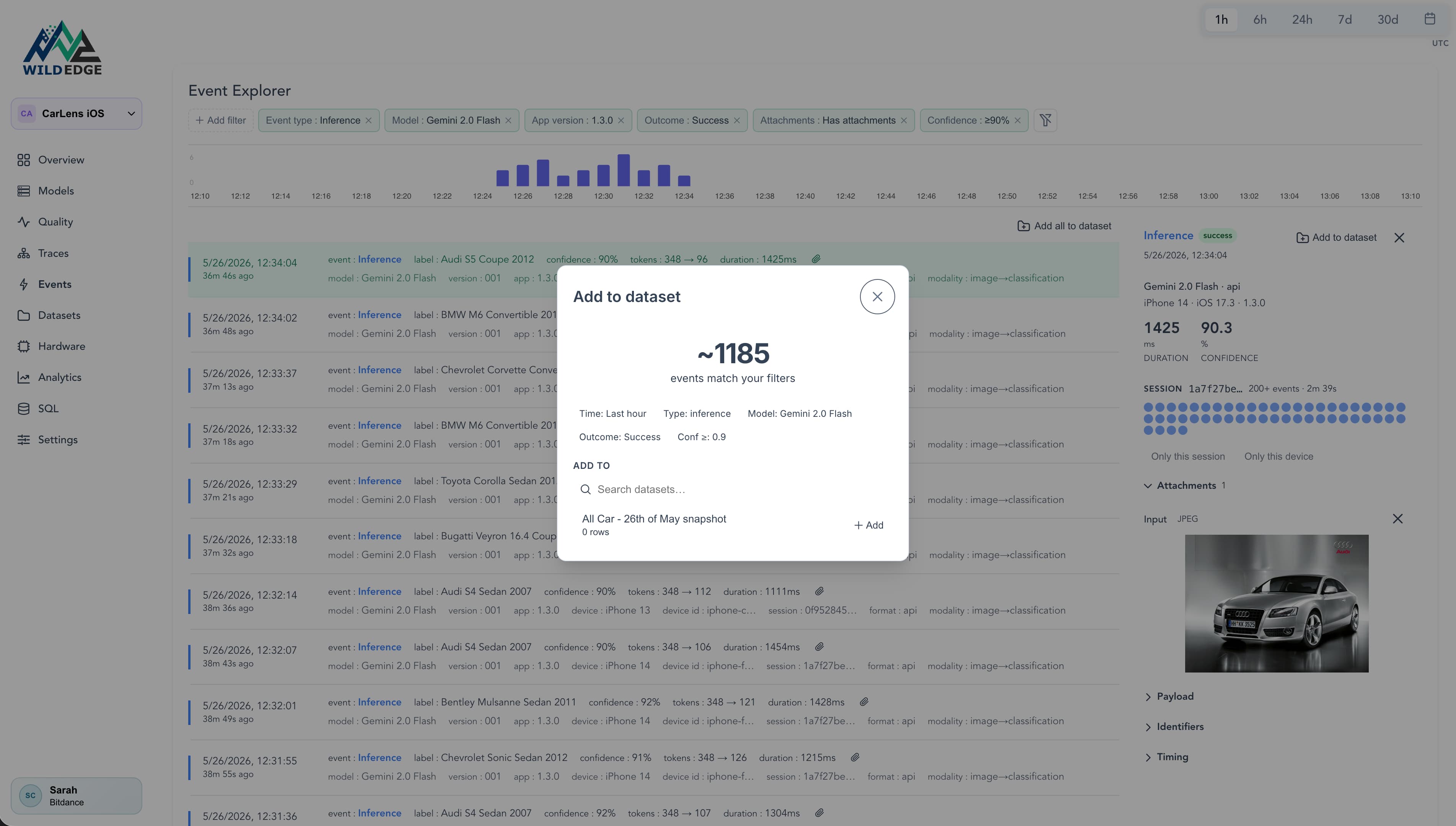
The SDK captures rich inference telemetry — outcomes, latency, confidence — while keeping your users' actual content private. No images, no audio, no text ever leaves the device.

Step 1 — On Device

SDK instruments every inference

The SDK captures inference outcomes, confidence scores, latency, hardware events, and input statistics — but never the raw inputs themselves. For images, only brightness and blur stats. For text, only token counts and language.

Step 2 — Sync

Batched, privacy-safe sync

Events are buffered locally and synced in batches — on a schedule or when the app backgrounds. No raw images, no raw audio, no raw text. Ever. What reaches the server is structured telemetry about model behaviour, not user content.

No raw inputs, by design
Step 3 — Dashboard

Know before your users do

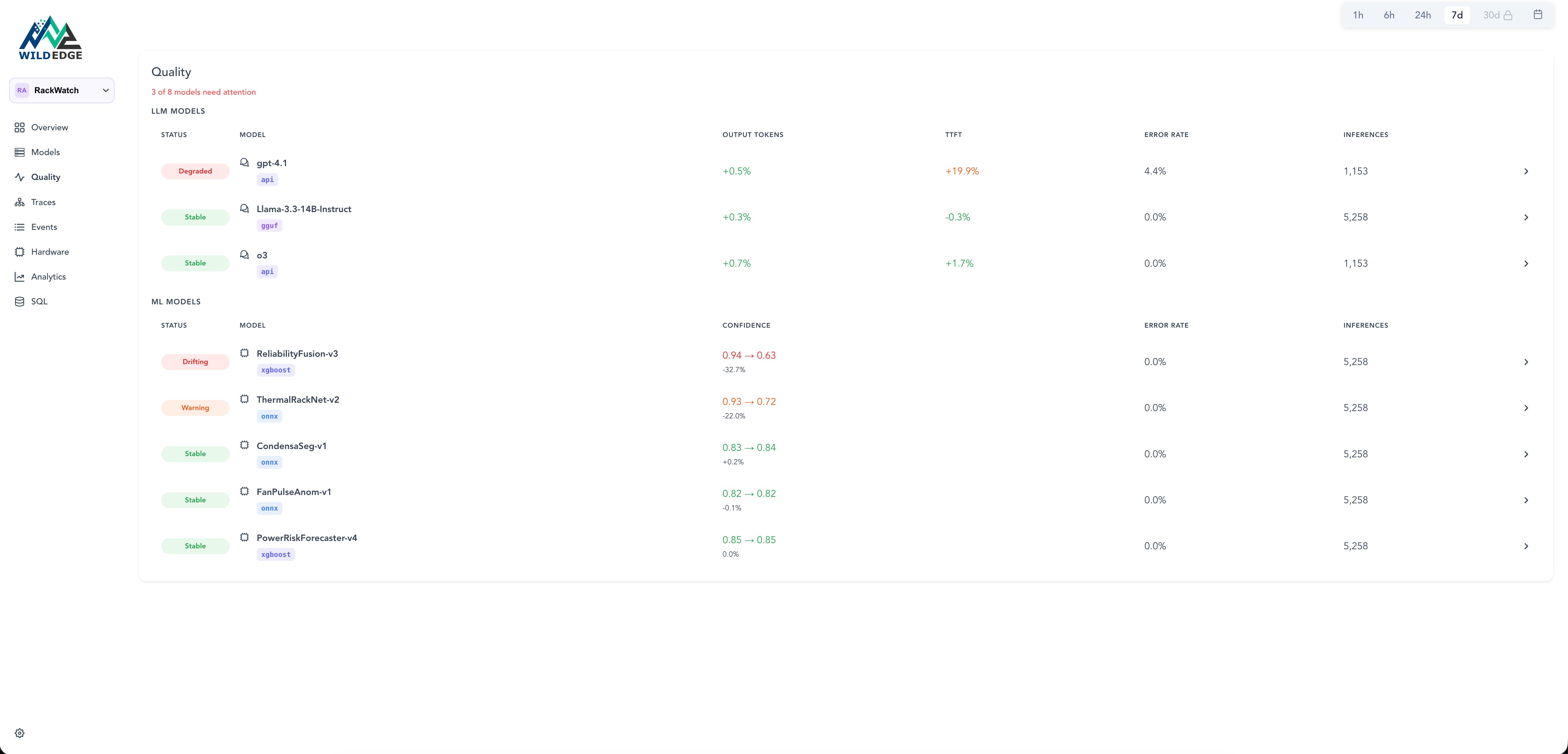
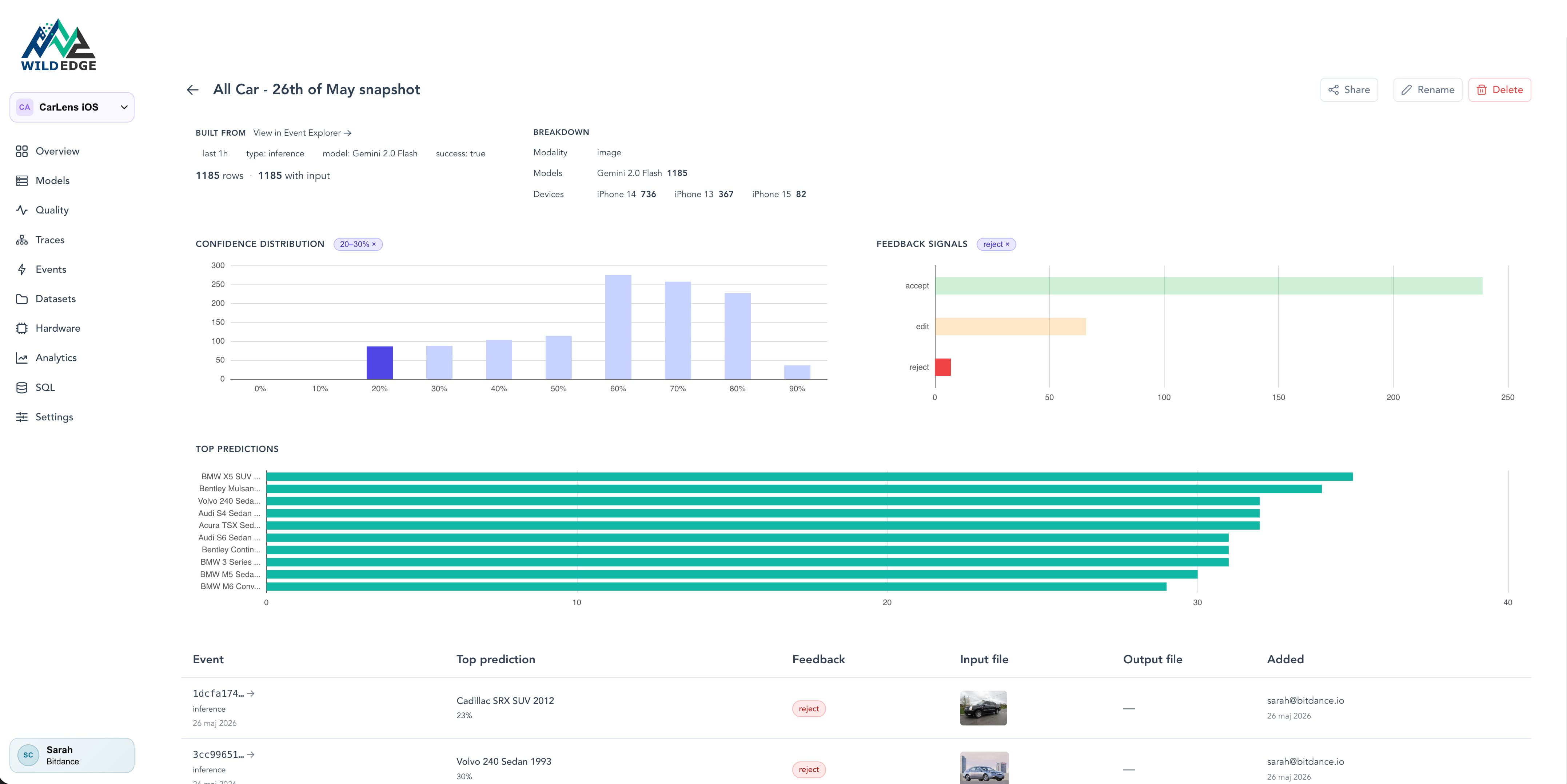
Wild Edge aggregates summaries from across your fleet, runs drift detection, and alerts you the moment something goes wrong — broken down by device model, OS version, quantization format, and hardware accelerator.

5-minute integration

Instrument once.
Never log again.

Framework integrations patch your runtime at init time. Your inference code stays exactly as it is — no log calls, no manual timers, no changes to model loading.

InferenceManager.swift
import WildEdge

// That's it. configure() swizzles MLModel.prediction(from:) at runtime.
// Every CoreML model in the app is instrumented — including third-party SDKs.
WildEdge.configure(apiKey: "we_live_iddqd")

// Use CoreML exactly as before — nothing else to change
let model = try YOLOv8n(configuration: .init())
let result = try model.prediction(input: features)
// ↑ latency, confidence, Neural Engine vs CPU fallback — all captured

No log calls scattered through your code · No raw data leaves the device · Works offline

Purpose-built analytics

Not just latency.
Answers.

Wild Edge shows you what generic APM tools can't — the intersection of ML performance and real-world hardware.

Model × Hardware Matrix

"Your model is 40% slower on iPhone 12 vs iPhone 13 due to Neural Engine limitations." Break down every metric by device model, accelerator, and OS version.

Thermal Correlation

"Prediction accuracy drops when the phone is over 40°C because the GPU is being throttled." Catch the invisible performance killer hiding in your users' pockets.

Quantization Loss Tracking

"Your INT8 model is drifting faster than your FP16 version in production." Compare model variants side-by-side across real device fleets.

On-device LLM Telemetry

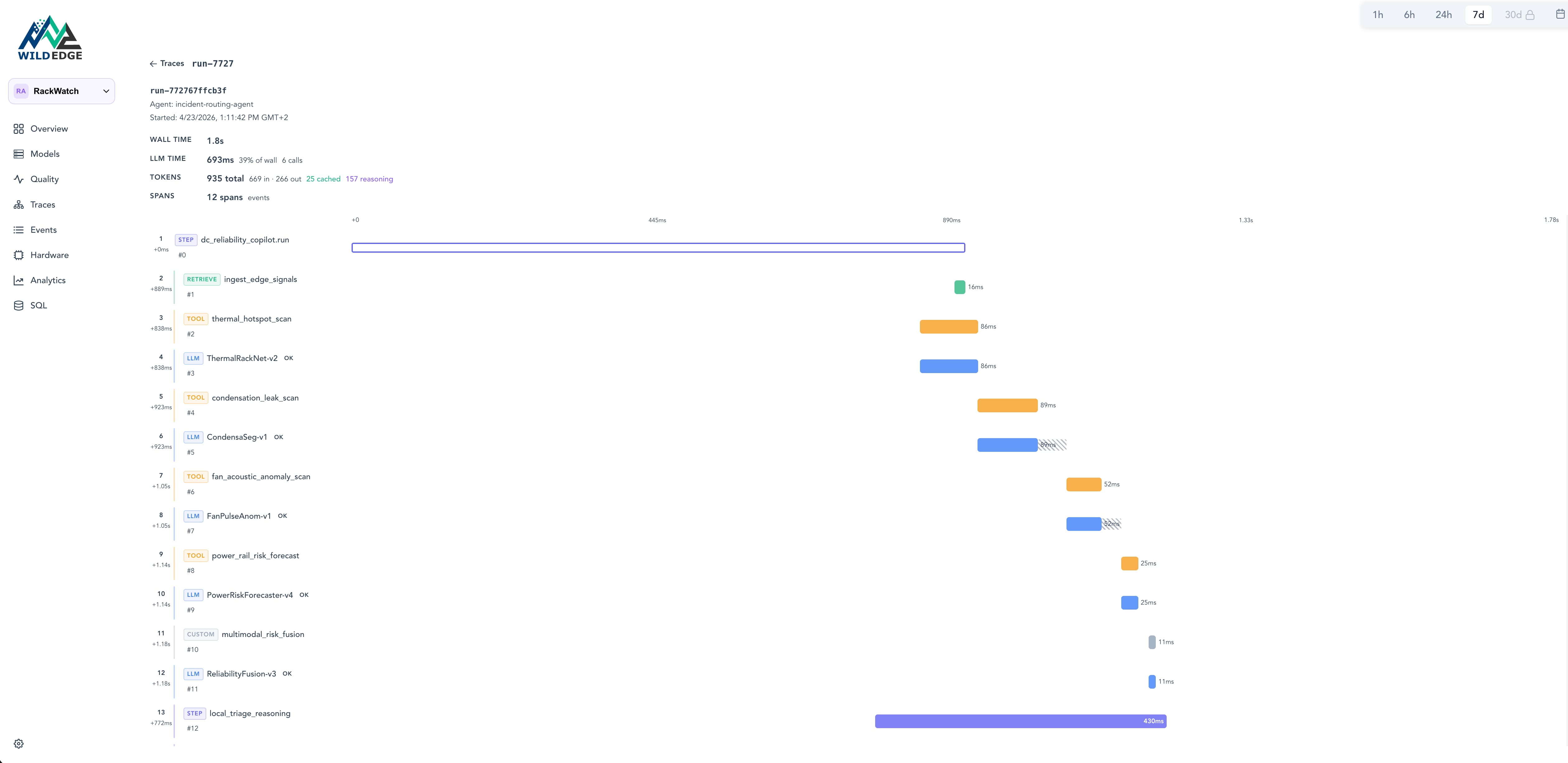
Track tokens/sec, time-to-first-token, KV cache usage, and context utilization for GGUF, CoreML, and ONNX language models running on-device.

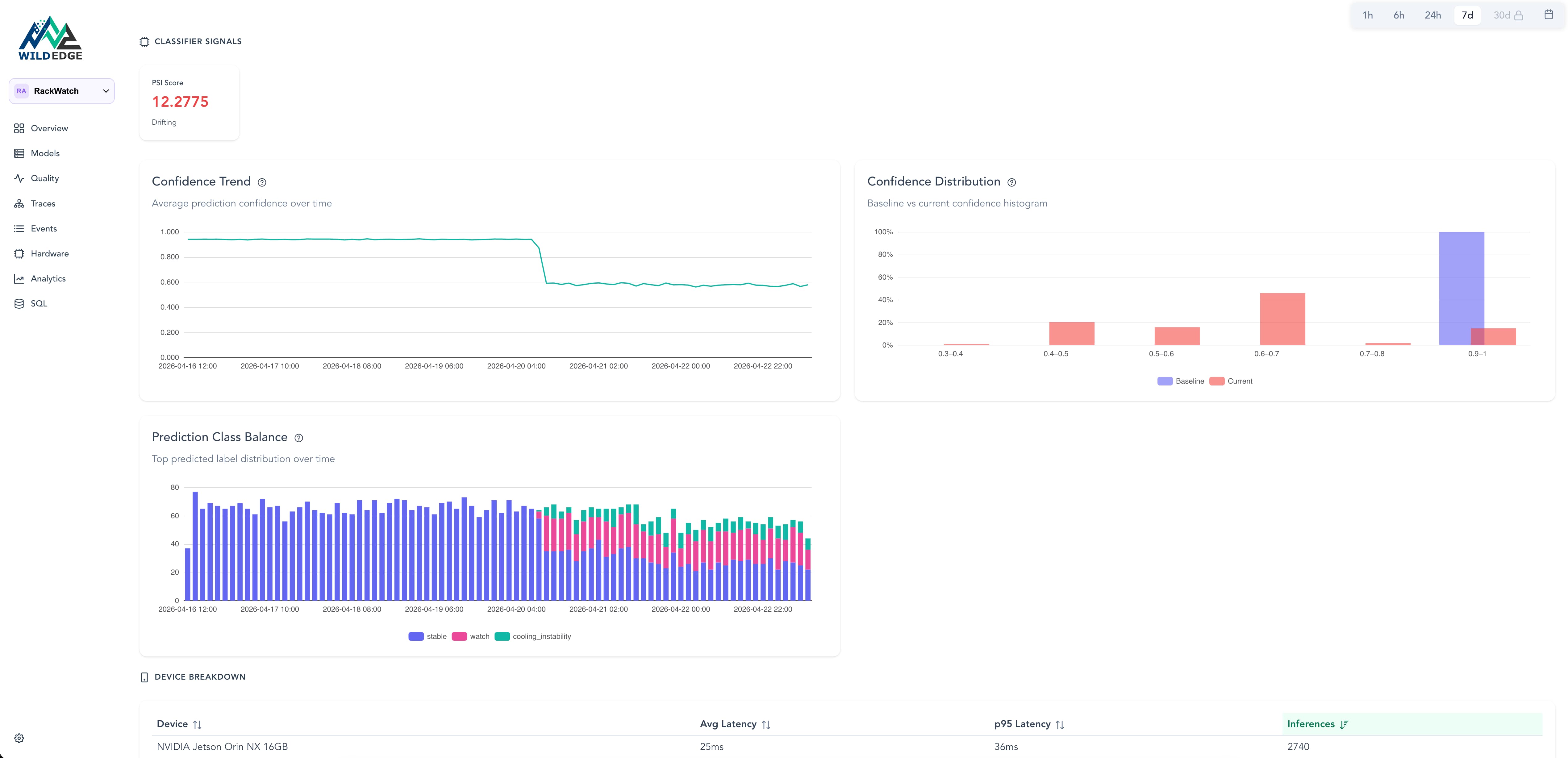
Confidence & Distribution Drift

Automatic drift detection across confidence scores, label distributions, and input statistics. Get alerted before accuracy degradation reaches your users.

For PMs

Model Version A/B

"Is v2.1 actually better than v2.0 on the real fleet?" Tag model versions and compare drift rates, latency, and confidence side-by-side across device cohorts. Ship updates with data, not hope.

Privacy by Design

We never see the user's images, audio, or text. Only the statistical shape of model performance. Pass your Apple ATT audit without breaking a sweat.

ATT-compliant by architecture

First-class support for every on-device inference stack

CoreML
iOS / macOS
TFLite
Android / Linux
ONNX Runtime
Cross-platform
GGUF
On-device LLMs
ExecuTorch
Meta / mobile
TensorRT
NVIDIA / Jetson

Also: SNPE / QNN · OpenVINO · MediaPipe · NCNN · any custom C runtime via the C SDK

Embedded & Firmware

Not just mobile.
Any edge.

Shipping ML on a Jetson Orin, Raspberry Pi 5, or a Cortex-A MCU? Wild Edge's C SDK and Python client work on bare Linux, RTOS, and store-and-forward environments where there's no persistent connection.

NPU / DSP / CPU breakdown

See inference latency and accuracy segmented by which accelerator actually ran the model — Hexagon DSP, Mali GPU, or fallback CPU.

Offline-first, store-and-forward

Events buffer locally in SQLite and flush when connectivity is available — whether that's WiFi, cellular, or a daily USB sync.

Fleet variance across hardware SKUs

Your model may run fine on the dev board but degrade on production hardware. Wild Edge surfaces that before a firmware OTA rolls out.

Wild Edge — object_detector · Jetson Orin fleet
synced 4 min ago
847
devices
9.4ms
avg latency
95.2%
confidence
3
alerts
Avg Confidence · 14d ↓ −1.8% drift
By Device SKU
SKU units accel p50 conf
Orin NX 16GB 312 DLA 8.7ms 96.2% ✓
Orin NX 8GB 389 DLA 9.1ms 95.8% ✓
AGX Orin 89 DLA 6.3ms 97.1% ✓
Orin Nano 57 GPU 31ms 93.4% ⚠
Orin Nano has no DLA — GPU-only SKU
57 units running 3.4× slower than fleet avg. Consider shipping a dedicated INT8 variant for this SKU.
Simple Pricing

Priced per model.
Scales with your fleet.

Because the compute happens on the user's device, our infrastructure costs are minimal — and we pass those savings on to you. One model, one line item.

Indie
Free
Forever, no credit card
  • 1 model
  • Up to 10,000 MAU
  • 7-day data retention
  • Drift & latency alerts
  • Hardware matrix
  • Thermal correlation
Get Started
Most Popular
Pro
$99/mo
per monitored model · up to 5 models included
  • Up to 5 models
  • Up to 100,000 MAU
  • 90-day data retention
  • Drift & latency alerts
  • Hardware matrix
  • Thermal correlation
Start Free Trial
Enterprise
Custom
100k+ MAU or multiple apps
  • Unlimited models
  • Unlimited MAU
  • Custom data retention
  • SSO & audit logs
  • Dedicated support SLA
  • On-prem deployment option
Contact Sales

Your model is in
5 million pockets.

Do you know how it's performing right now? Set up Wild Edge in 5 minutes and find out.

Free up to 10k MAU · No credit card · SDK for iOS, Android, and Linux